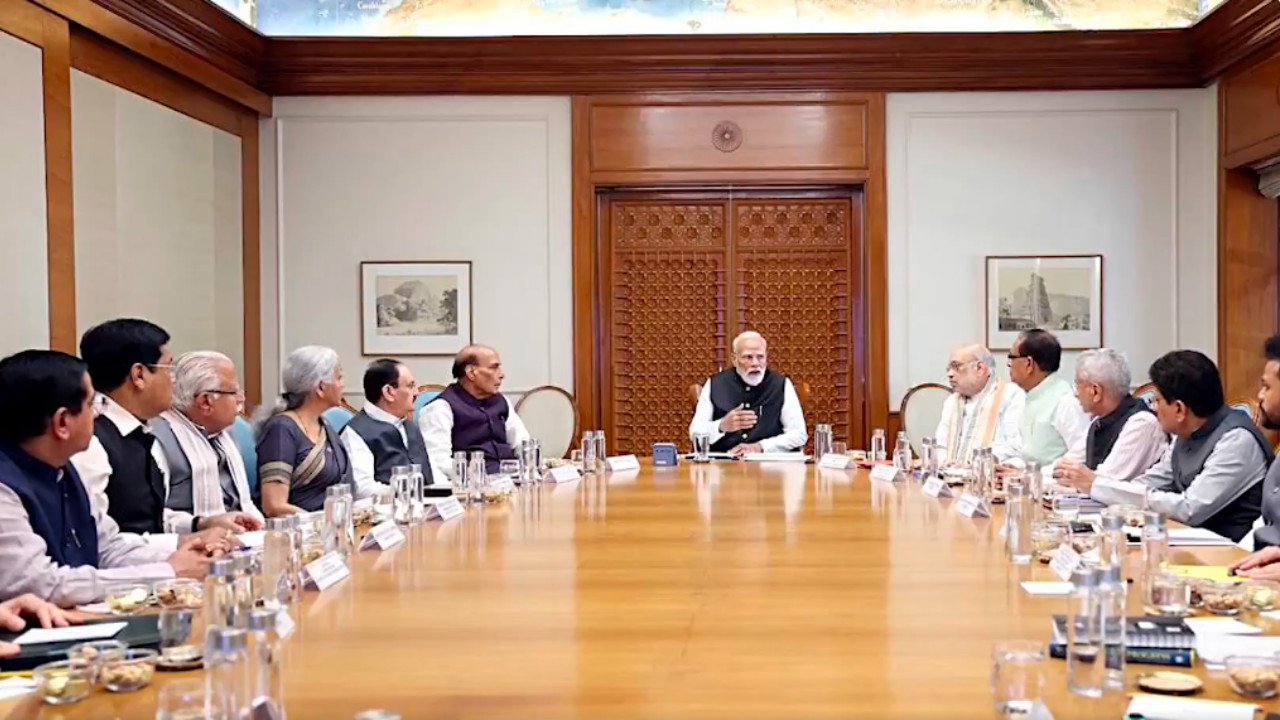
The 8th Pay Commission is a big ray of hope for central government employees. (Image X @ANI)
New Delhi: The 8th Pay Commission is a big ray of hope for central government employees. Six months after the formation of the commission, the first meeting was held with employee unions, where huge demands were put forward on behalf of the employees. The discussions held in this meeting on the minimum wage and fitment factor have now created a huge stir everywhere.
Since these changes are likely to come into effect from January 1, 2026, there is a lot of curiosity about how much money will come into the pockets of the employees.
The NC-JCM alliance has dropped a big bombshell in the 51-page memorandum submitted to the commission. Their main demand is that the current minimum wage should be increased directly to Rs 69,000. Not only that, they have also demanded that the wage hike given every year should be doubled from the current 3 percent to 6 percent. The employees argue that life is difficult if the salary does not increase in line with the rising price increase or inflation.
This fitment factor determines how much the salary should increase. The employees' unions have demanded that this fitment factor be set at 3.833. If this is implemented, a huge increase can be seen in the basic salary of the employees. This time, the employees have come to the meeting with a solid plan with the aim of saying, "Salary alone is not enough, it should improve our standard of living."
As important as salary is the house rent allowance or HRA. This time, there is a demand that the HRA should be changed according to the classification of cities. Those living in metropolitan cities should get 40 percent of the basic salary, 35 percent for second-tier cities and 30 percent for third-tier cities, the employees' request is that house rent should be 30 percent. This will provide great relief to the employees in rented houses.
In this meeting, which was led by former Supreme Court Justice Ranjana Prakash Desai, every pain and demand of the employees was listened to. Economists Pulak Ghosh and Pankaj Jain, among others, were present in the meeting and thoroughly examined the 51-page list of demands of the employees. An estimate was also made of how much burden these demands of the employees would pose to the government.





Copyright © 2026 Top Indian News